 CrazyGamesX.com
crossy road crazy games quick-start guide
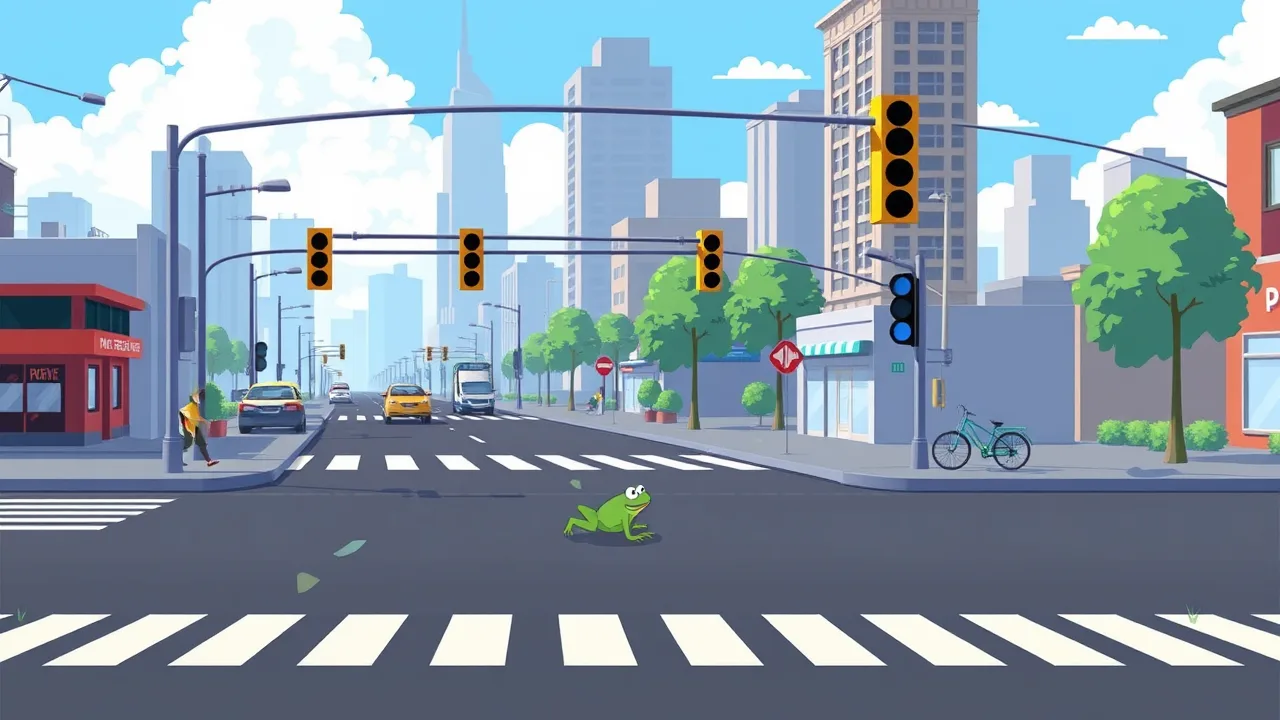
If you vibe with one-tap arcade chaos, crossy road crazy games is your lane. It’s a modern riff on classic “cross-the-street-without-dying” design where timing and tile awareness matter more than raw reflex spam. Think Frogger for 2025 attention spans, but with cleaner hitboxes, tighter camera framing, and satisfying micro-goals every few seconds. The blueprint was popularized by the mobile hit Crossy Road, a slick, voxel-styled arcade title that codified the whole “infinite road-crossing” loop (see the background on Crossy Road). On desktop, the experience translates beautifully: crisp inputs, predictable obstacle cycles, and quick resets that make “one more try” an actual threat to your schedule. If you want the purest browser taste of this formula, jump into the chicken chaos here mid-session with Crossy Road Chicken and see how far your pattern-reading really goes.
The core loop of crossy road crazy games explained simply 🧠
It’s dead simple: advance one lane at a time, survive, and stretch a streak. Lanes generate hazards on cycles: vehicles with velocity bands, water logs with drift speeds, trains with hard one-shots, and occasional bait coins pulling you off rhythm. You tap or arrow to step, you wait for a pocket, you collect, repeat. The soul of the loop is tempo control. If you move every beat, you’ll walk into desyncs; if you hesitate forever, the camera pressure and lane spawns close the window. The game rewards three habits: lane scouting (peek next two lanes before stepping), micro-stutter (half-beats to reset timing), and greed discipline (skip coins when patterns look cursed). Missed inputs are rarer on desktop, but don’t mash. Treat each step like chess: you’re trading position for risk. That’s why runs that feel “slow but clean” consistently outscore YOLO dashes. No mystery, just fundamentals stacked clean.
Where crossy road crazy games fits in today’s gaming landscape 🌍
This sits squarely in the arcade micro-session niche: fast boots, short commitments, infinite mastery curve. It’s the antidote to bloated live-service checklists. In a world of inventories and dailies, crossy road crazy games offers pure mechanics: read, decide, step. It bridges audiences too. Mobile players know the grammar already, speedrunners sniff out deterministic cycles, and casuals love the “fail fast, learn faster” loop. It’s also streamer-friendly: visible stakes every second, chat-callable throws, and instant “go again” energy. Compared to endless runners, the grid adds tangible landmarks and cleaner teaching moments. Compared to puzzle-arcades, the action never stalls. Schools and offices tolerate it better than shooters, and the tech footprint is featherweight, so low-spec laptops stay in the game. Bottom line: this is evergreen arcade design dressed for the browser era. It quietly sits in your bookmarks, waiting to steal your coffee break.
Unlocks, skins, and collectibles in crossy road crazy games 🧰
Cosmetics are the spice, not the meal. Expect character skins that tweak read clarity (hitbox visuals stay fair), ambient SFX swaps, and seasonal palettes. The value here is motivation and readability. High-contrast skins make traffic patterns pop; themed sets keep you grinding a few more runs. Coins are your soft currency: grab them in-run when the pattern is safe, not when it’s screaming bait. Some versions add milestone rewards—distance thresholds that drop small bundles—or streak chests if you chain clean runs. Daily spins are fine, but don’t let them drag you into bad tempos chasing one more shiny. If you’re playing the browser build at Crossy Road Chicken mid-session, treat cosmetics as optional clarity upgrades: pick a model you can track at a glance, especially in rain or low-light lanes. Style’s cute; visibility wins streaks.
Positioning fundamentals every crossy road crazy games player needs 📐
Think diagonals and off-center lanes. Parking yourself slightly left or right widens your cone of safety because incoming cars become visible a beat earlier. Enter water lanes from the upstream side, landing near the front of a log so you buy correction time. Trains? Never hover near tracks on odd beats; step in and out with intent. When coins spawn in the “danger diamond” (between two fast lanes), pass unless your read is perfect. Count gaps, not cars—identify the repeating “safe pocket” and move to inhabit it. If a lane offers a full stop on a neutral tile, take it to re-sync your internal metronome. And remember camera squeeze: vertical pressure punishes idle. You’re always trading space for information. Good positioning means you see one lane ahead without committing to it. If you can’t explain your next two steps, your current tile is wrong. Fix that first.
Play crossy road crazy games in the browser: zero downloads ⚡
No installs, no launchers, no driver tantrums. Hit play, learn the beat, cook a streak. Browser builds like Crossy Road Chicken boot fast because assets are tiny and the simulation is simple. You get instant restarts, which is critical for skill acquisition: more reps per minute equals faster pattern fluency. Keep it in a pinned tab for micro-sessions. If school or work filters are strict, try a different network segment or a personal hotspot, but always respect your local rules. Fullscreen helps reduce accidental scrolls, and windowed mode is fine if you’re alt-tabbing between tasks. The big perk here is hardware forgiveness—integrated graphics are plenty. If your input feels sticky, kill background tabs, disable unnecessary extensions, and lock your display to 60 Hz for stable frame pacing. Clean pipeline, clean runs.
Low commitment, high payoff: crossy road crazy games in short bursts 💫
Five minutes is enough to warm the hands, learn a new spawn rhythm, and bank a PB. That’s why this loop slaps for busy players: you get dopamine without the chore list. The learning curve is spicy but friendly—failures are readable, so improvement feels earned. You’ll notice concrete gains in a single lunch break: better hesitation timing, cleaner diagonals, fewer panic steps. And because runs are modular, you can stop anywhere without losing progress anxiety. Score a streak, close the tab, done. There’s spillover, too. Rhythm skills from this game translate into other reaction-heavy titles—platformers, runners, even shooters, because you’re training your internal clock. If you want a fast “I still got it” check, queue a session at Crossy Road Chicken, set a small goal (beat 60, then 80, then 100), and let compounding reps do the work.
Similar Games crossy road crazy games 🐔
Jumpy Frog
If you want the OG crossing energy with clean tile reads, Jumpy Frog brings classic lane logic with modern pacing. The beauty is in its predictability: vehicle rhythms teach quickly, so you graduate from luck to literacy fast. Mid-run, when you’re feeling dialed, pivot into a fresh cycle by hopping into Jumpy Frog and focus on diagonal entry timing. Don’t chase every coin—use them as rhythm checks. The camera pressure feels fair, which makes micro-stutter a legit tool rather than a panic button. Treat logs like moving platforms with buffer space at the nose, and always exit toward visual clarity, not greed. If Crossy taught you to respect trains, this one will teach you to pre-position two tiles early. That’s the difference between “almost” and “locked-in” on mid-speed lanes.
Frog Jump Online Game
This variant skews a touch faster on water sections, so drift management matters. Think of each log as a conveyor belt that pays or taxes your timing depending on entry. In the middle of your learning curve, rotate a block of runs through Frog Jump Online Game and drill upstream landings. Coins bait you toward the back edge—resist. The scoring curve rewards distance discipline over shiny distractions. Train cadence: step, micro-pause, step. Once you internalize cycle speed, you’ll start seeing “safe diamonds” emerge between hazards. That’s your green light to cross two lanes in one breath. Keep your cursor discipline tight if you use mouse input; unplanned diagonals are the number one throw here.
Traffic Racing Jam
More asphalt, more speed, more commitment. This one’s about reading velocity bands and identifying the repeating slow-car anchor that opens windows. In the thick of a session, swap to Traffic Racing Jam to practice “lane shadowing”: follow behind a safe vehicle until a pocket forms, then dart across. Peripheral vision is king—don’t tunnel on the near lane. Count beats out loud if you have to. Trains are rarer, but truck clusters can mimic their threat profile. If a lane looks noisy for more than two seconds, reset your position on a neutral tile and re-sync the metronome. That patience prints scores.
Red Runner
Same spirit, different flavor—a forward-scroller that rewards jump timing and floor awareness. It’s a perfect cross-training tool for your rhythm and spacing. Mid-paragraph switch into Red Runner and practice holding jump to adjust hangtime over double hazards. The trick is mapping obstacle tells: low walls want early presses, spike stacks want late taps, and coin arcs telegraph safe parabolas. If you’re missing platforms by half-tiles, you’re releasing on fear, not on read. Breathe, count two beats, and commit. These reps boomerang back into cleaner road crossings because your internal clock gets sharper.
Temple Run 2 Tomb Runner
A heritage runner with chunky feedback and crisp turn windows, great for training scan-ahead discipline. The isometric angle forces you to read further, which makes returning to grid crossings feel slow-mo easy. During a focused block, load Temple Run 2 Tomb Runner and push for clean 90-degree turns without over-swiping. Watch the coin lines—they often mark the safe apex of curves. Slide under fear, jump only on confirms, and tilt your eyes two segments ahead, not at your feet. When you bounce back to crossy road crazy games, that extra foresight translates into earlier, safer commitments across fast lanes.