 CrazyGamesX.com
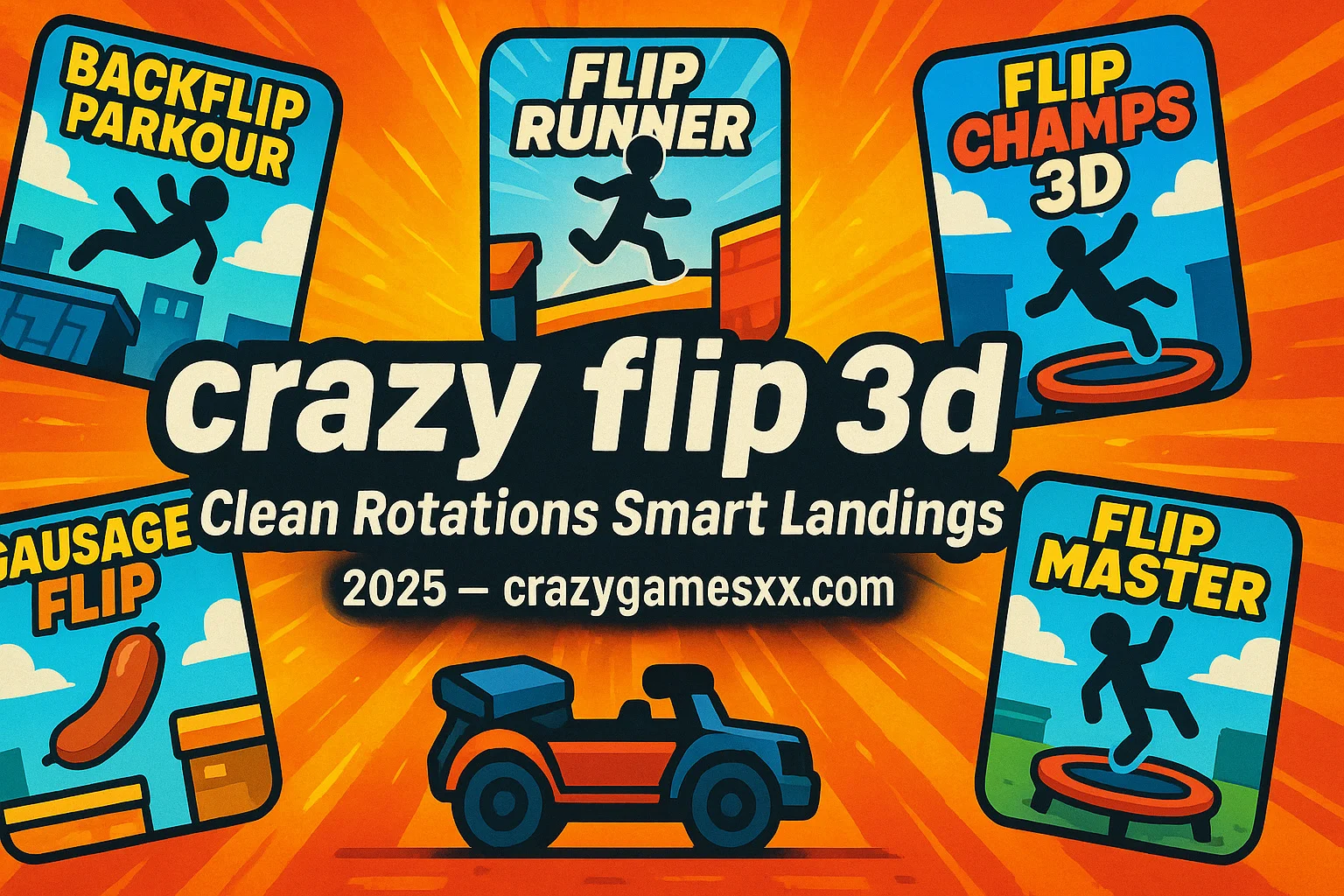
crazy flip 3d: Clean Rotations Smart Landings
Skill ceiling in crazy flip 3d: what separates pros from newbies
Newbies mash jump and pray; pros choreograph. At low skill, you’re reacting. At high skill, you’re planning—enter speed, flip angle, landing edge, and recovery input before you even leave the ground. Pros keep a mental metronome: jump timing in beats, rotation in counts, landing in silence. They also route levels: safest line for PB attempts, spicier line for WR pace. Micro-tech matters—feathering jump height, short-hopping to adjust apex, pre-buffering the next input on contact frames, and canceling momentum with micro-steps so you don’t slide off thin tiles. Watch their resets: instant, emotionless, back in. They log “trouble tiles” and practice them in isolation until they’re boring. Newbies tilt after two fails; pros treat fails like data. The other divider is consistency under pressure. Anyone can land a hero flip once. Pros land it ten times back-to-back with identical spacing, then save it for when the run is alive. That’s the difference between playing and performing.
Where crazy flip 3d fits in today’s gaming landscape
We’re in the era of snackable skill games: tight loops, instant restarts, and shareable clips. crazy flip 3d sits right next to precision platformers and parkour-lites—easy to start, devilish to master. It scratches the same itch as speedrunning without demanding a 2-hour commitment. For creators, it’s TikTok-gold: fast fails, tighter wins, and clean “from zero to hero” arcs in under a minute. For players, it’s the anti-grind: no battle pass FOMO, just raw improvement. It also complements your library—after sweaty shooters or macro-heavy MOBAs, you cleanse the palette with pure movement puzzles. On low-spec machines and school/work machines, browser builds make it frictionless, so it sneaks into more moments of your day. Add in level variety and quick updates, and you’ve got a modern arcade energy that keeps the genre very alive.
Signature features that define crazy flip 3d
Three things define it: precision timing, momentum control, and micro-levels. First, the timing window: jumps and flips have predictable arcs, and your job is hitting the “golden frame” where rotation ends exactly as your feet meet the platform. Second, momentum: you’re not just going up and down—you’re converting horizontal speed into arc height, trimming rotation mid-air with taps, and killing drift on landing. Third, level design: bite-sized stages that teach one idea at a time—springboards, moving planks, wind tunnels, or gravity toggles—then remix them nastier three screens later. Quality-of-life is clutch too: instant respawns, readable silhouettes, and hitboxes that feel fair. Good builds add optional challenges (coin lines, no-death medals) and simple cosmetics so the grind is skill-first, drip-second. Net effect: “one more try” turns into “okay, last 20.”
Positioning fundamentals every crazy flip 3d player needs
Position is king. Before you jump, square your toes to the platform edge; crooked takeoffs bleed distance. Use the last pixel: edge-buffering buys frames for taller gaps. Aim to land heels-first on narrow tiles—heels absorb drift; toes slip. On moving platforms, meet the platform’s speed: take off earlier if it’s leaving you, later if it’s coming in. For stacked flips, treat each rotation like a checkpoint—finish one clean before committing the next. If a stage has wind or conveyors, adjust your launch point, not your panic taps mid-air. On tilting tiles, land center-mass, then micro-step to stabilize before jumping again. And always pre-aim your next two steps—where you land and where you’re launching from next. Good positioning makes timing easier; bad positioning forces heroics. Don’t rely on heroics.
Play crazy flip 3d in the browser: zero downloads
No installers, no updates, no driver drama—just click and flip. Browser builds make crazy flip 3d the ultimate stealth game for short breaks. Keep your windowed mode ready, cap FPS if your laptop’s cooking, and use Fullscreen only when you need max focus. Latency is basically input processing: close background tabs, disable heavy extensions, and lock your touchpad so stray swipes don’t yoink your run. If you’re on a school or office network, load once and let caching do the work; most stages stream tiny assets, so bandwidth is chill. Controller users: plug in and test dead zones; if the stick floats, go D-pad or keyboard. Keyboard-only is meta anyway—space to jump, arrow or WASD to nudge. If your machine wheezes, drop the resolution or toggle effects in settings and keep the frame pacing smooth.
Why crazy flip 3d is easy to learn, hard to master
The inputs are baby-simple—jump, flip, land—but the execution lives in millisecond decisions. The game teaches with failures you can instantly fix: you were early, late, too fast, or too crooked. Mastery is stacking tiny advantages: consistent takeoff pixels, optimal flip counts, and smooth recoveries after imperfect landings. Because levels are short, your brain gets dozens of clean reps per session; that’s how muscle memory forms. The challenge scales with your ambition: beat the stage, then beat it deathless, then speedrun, then no-coin low-jump insanity for the flex. The joy is watching your “impossible” become warm-up. That’s why veterans still grind daily—there’s always a cleaner line, a tighter split, a scarier skip you can make feel free.
Similar Games to crazy flip 3d
Backflip Parkour
If you want the freestyle side of flipping, this one leans into aerial control and stylish landings. You’ll chain backflips across rooftops, manage momentum on sloped surfaces, and thread needles between obstacles. The middle of each route usually hides a line that feels illegal but isn’t—find it, commit, and ride the flow. When the level adds moving rails, pre-aim your landing so your shoes meet the pace, then pop instantly into the next jump. For a browser-quick hit that mirrors the “flip, rotate, stick it” loop, jump into Backflip Parkour while your coffee is still warm. It’s great for practicing controlled rotations, so when you return to crazy flip 3d, you’ll bring steadier timing and smarter approaches to narrow ledges.
Flip Runner
Flip Runner is a pure movement exam: sprint, jump, flip, land—repeat until your brain hums. The early maps teach respect for takeoff angles; later maps punish lazy arcs with hilarious fails. Watch for sections that tempt greed; better to split a double into two clean singles than eat pavement chasing clout. Use short hops to micro-adjust height without over-rotating, and always watch your feet, not your character’s face—the soles tell you if you’re about to slide. Speedrunners will love the “skip windows” where an early flip cuts a platform entirely, but lock consistency before you chase records. It’s the perfect drill partner for crazy flip 3d: same physics reads, faster rhythm, and more chances to groove into that flip-land tempo.
Flip Champs 3D
Training arc one: basic rotations. Training arc two: rotations under stress. Flip Champs 3D piles on moving targets, variable gravity, and slanted surfaces that test your landing discipline. The best habit here is “edge respect”—launch late, land early, and never hover in indecision. When platforms start shifting mid-air, treat each as a rendezvous: match its motion, kiss the center, and leave before drift bites. You’ll learn to make flips smaller, tighter, and more deliberate, which pays dividends in crazy flip 3d where tiny overshoots cost runs. Bonus: the visual clarity makes reading depth easier, so your brain stores better landmarks for future maps. Come for the flips; stay for the repeatable, measurable improvement.
Sausage Flip
Don’t let the meme skin fool you—this is a precision playground. The physics are intentionally squirrely, which forces you to learn body control and conservative angles. Mid-stage, when the game teases a YOLO leap, take the smarter line and build a buffer before attempting the spicy route. Try planting partial landings—half the body on, half off—to kill momentum before the next hop. Somewhere in the middle of a run, slide into Sausage Flip to practice patience under goofy physics. That patience translates back to crazy flip 3d when moving tiles and bouncy pads try to bait you into panic inputs. Mastery here isn’t about speed; it’s about restraint and control.
Flip Master
When you want macro control over flips—height, rotation count, landing frame—this is the lab. Flip Master lets you micro-tune airtime and commit to cleaner finishes. Use it to develop a “flip cadence”: count rotations, breathe on takeoff, exhale on landing. Practice ending spins just before contact to avoid late-landing wobbles that push you off narrow targets. Mid-way through sessions, swap to this for ten focused reps on a move you keep scuffing in crazy flip 3d—then go back and cash the improvement. Because the feedback loop is so fast, you’ll notice gains inside a single sitting. It’s the closest thing to a flip dojo you’ll find in your browser.