Experience Best Driving
Dance On Hotsteps Mobile
City Auto Rickshaw Game
Anomaly Content Record
Crazy Three Puzzle
Christmas Bubble Shooter Game
Last Z Survival Shooter
Moto Bike Extreme Hill Stunts
Brainrot Bridge Race 3D
Survive The Night
COSMOS 404
Mission Santa: Deliver the Gifts
Sniper Shooting Offline Games
Annoying Uncle Punch the Meme
Scratch To Win Game
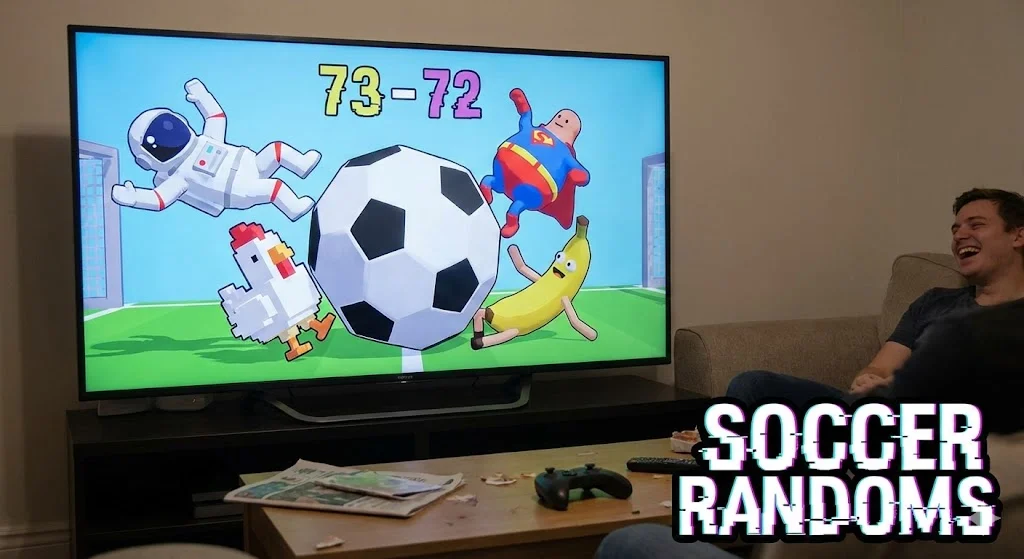
If you have ever wanted to play a sport where skill takes a backseat to hilarity, you are in the right place. This isn't your typical serious simulation; it is a chaotic, pixelated showdown where gravity often feels like a suggestion rather than a rule. You might be trying to score a goal, but suddenly you are playing on an icy field with a heavy beach ball, and your characters are tumbling over each other like sawdust dolls. It captures that specific joy of browser gaming where you can jump in for five minutes or lose an hour trying to beat your friend. For anyone looking to jump straight into the madness, you can find the game at soccer randoms and start flailing your way to victory. The mechanics rely heavily on what is known as ragdoll physics, which means your players' limbs react dynamically and often ridiculously to every impact.
Finding games that actually run smoothly on school hardware can be a bit of a nightmare. We have all been there trying to load a graphics-heavy title on a Chromebook or a dusty library PC, only to watch it stutter and crash. The beauty of this title lies in its simplicity. It doesn't require a high-end graphics card or a massive download; it runs directly in the browser with minimal overhead. This makes it the perfect candidate for quick sessions during study breaks or downtime. Because the code is lightweight, you aren't likely to trigger the loud cooling fans that give you away in a quiet classroom. It’s designed to be accessible, meaning whether you are on a restricted network or an older laptop, the game usually loads instantly. You just open the tab, hit the button, and you are playing. No login walls, no massive updates, just instant, unblocked fun that fits perfectly into a five-minute gap in your schedule.
One of the features that keeps the gameplay fresh is the constantly shifting environment. In a standard sports game, the grass is always green, and the goalposts never move. Here, randomness is the core mechanic. One round you might be kicking a standard football on a traditional grass pitch, and the next, the background shifts to a snowy winter landscape where the players slip and slide with reduced friction. It doesn't stop at weather; the game often throws you onto a sandy beach where the physics feel slightly heavier, or into backyard settings that change the vibe completely. The goal sizes might shift, or the obstacles in the background might change, forcing you to adapt your timing. It prevents the "one-button" mechanic from getting stale because you can never quite predict how the ball or your players will react to the terrain. You aren't just battling the opponent; you are battling the level itself, which seems to have a mind of its own.
Let’s be honest, not everyone wants to memorize twenty different button combinations just to pass a ball. Sometimes you just want to mash a key and see something funny happen. This title defines the casual genre by stripping away the complexity of fouls, offsides, and stamina bars. It is pure arcade energy. The loop is incredibly short: a match is first to five goals, and rounds can end in seconds. This makes it ideal for low-stress gaming. You don't need to worry about ranking down or ruining a win-streak because the stakes are nonexistent. It is the kind of game you play while listening to a podcast or chatting with friends on Discord. There is no meta to study, no economy to manage, and no "wrong" way to play. If you accidentally kick the ball into your own net because your striker did a backflip, you just laugh and start the next round. It returns gaming to its roots: simple, accessible fun without the grind.
The movement system here is deceptive. On the surface, it looks like you have very little control, and in many ways, you don't. You press one button, and your two-character team jumps and kicks simultaneously. However, the nuance comes from the timing and the momentum. Since you control the angle of the jump by when you press the key relative to your players' current stance, you can actually pull off some surprising maneuvers. If your player is leaning back, a tap might launch them into a bicycle kick. If they are falling forward, a tap might face-plant them into the ground, acting as a defensive block. Understanding this wonky momentum is key. You aren't steering them left or right directly; you are adding energy to a physics simulation and hoping the vector aligns with the ball. It feels clumsy at first, but after a few matches, you start to "feel" the rhythm of the hops and tumbles, allowing you to intercept aerial balls or block shots with a well-timed flop.
The real magic happens when you drag a second human into the mix. Playing against the CPU is fine for practice, but the AI doesn't scream in frustration when a ball bounces off three heads and trickles into the goal. The local two-player mode is where this game shines. You share a keyboard one person on the Up arrow, the other on 'W' and it becomes a battle of attrition and button-mashing speed. The psychology changes in PvP. You start trying to bait your friend into jumping early, leaving their goal exposed, or you try to pin their players down with your own bodies. Since the physics are so unpredictable, the "skill gap" is hilariously narrow. A complete novice can beat a veteran just by getting lucky with a beach ball bounce. This levels the playing field and makes it a fantastic party game. It’s less about tactical dominance and more about who can manage the chaos better without losing their composure (or their fingers) in the process.
In modern gaming, we are used to having full control over our view swinging the mouse to check corners or zooming in for better aim. Here, the camera is strictly fixed, side-scrolling, and automated. It zooms in and out dynamically based on where the ball is and how far apart the players are. While you cannot adjust this yourself, understanding how the camera behaves is actually part of the strategy. When the ball goes high, the camera pans up, sometimes cutting off the view of the ground. This can be disorienting, and you might lose track of exactly where your goalkeeper has landed. You have to develop a sense of object permanence, remembering where your defender was before the camera zoomed in on the striker's aerial duel. It simplifies the game for the better; you don't need to fiddle with thumbsticks to see the action. The director is the code, and it does a decent job of keeping the essential chaos in frame, even when players are flying off-screen.
It sounds ridiculous to talk about "mental game" for a game involving pixelated ragdolls, but maintaining your cool is surprisingly important. The physics can be infuriating. You will have moments where you have a perfect shot, and your player decides to do the splits in mid-air and miss the ball entirely. If you let that tilt you, you will start spamming the jump button. Spamming is the enemy of success here. When you mash the key, your players flail uncontrollably, often ending up on their backs like overturned turtles. The best mindset is one of "controlled patience." Wait for the players to land before jumping again. Accept that randomness will sometimes screw you over. If the enemy scores a lucky goal because the wind blew the ball weirdly, just reset. The rounds are fast. If you get frustrated and play too aggressively, you usually end up scoring on yourself. breathe, laugh at the absurdity, and wait for your opening.
A common question new players have is whether they can select specific maps or weather conditions. The short answer is no, and that is by design. The "Random" in the title isn't just for show. Every time a goal is scored, the game rolls the dice on the next round's parameters. You might ask, "Are some modes harder than others?" Absolutely. The rounds with the smaller goals and the heavy medicine ball are significantly lower scoring and often turn into wrestling matches in the center field. Conversely, the "Beach" mode with the light ball often results in high-flying, accidental goals from across the map. Players also wonder if the different character skins affect stats. Generally, the hitboxes feel consistent regardless of whether your team is wearing suits or swim trunks, though the visual clutter of some skins can sometimes make it harder to see exactly where your foot connects with the ball. Embrace the lack of choice; it forces you to be adaptable.
While the game doesn't follow the traditional "Live Service" model with Battle Passes and daily logins, the concept of "seasons" is built directly into the gameplay loop. You experience all four seasons and then some within the span of a single match. You don't have to wait for a Christmas update to play in the snow; the game might throw a winter round at you in the middle of July. However, developers of these types of web games often quietly tweak the physics or add new background assets to keep things interesting. You might notice subtle changes in how the ball interacts with the corners or new "jersey" colors appearing in the rotation. The variety is what keeps the retention high. It feels like a new "season" every time you boot it up because the combination of ball type, field friction, and obstacle placement creates a scenario you might not have seen before. It is content generation through procedural chaos rather than a scheduled content roadmap.
Even the simplest browser games can have hiccups. If you find the game is lagging or the inputs feel delayed, the first culprit is usually browser extensions. Ad-blockers or heavy script blockers can sometimes interfere with the game's execution code. Try running it in an Incognito or Private window to see if the performance improves. Another common issue is the "stuck key" syndrome, where your player keeps jumping automatically. This often happens if you click outside the game window while holding a key down. Simply clicking back into the game frame and tapping the key once usually resets the input. If the game refuses to load entirely, clearing your cache is the classic fix. Since the game relies on local assets caching for speed, sometimes a corrupted file gets stuck. Lastly, ensure you don't have too many heavy tabs open in the background; even pixel physics require some CPU power, and a browser cluttered with video streams can slow down the ragdoll calculations.
1. Can I play this soccer randoms game on a mobile device? Yes, the game is built with HTML5, making it responsive on most modern smartphones and tablets. The controls are adapted for touchscreens, usually involving tapping the side of the screen corresponding to your team to jump and kick.
2. Is there an online multiplayer mode? Currently, the game is designed primarily for local multiplayer (two people on the same device) or single-player against the CPU. There is no native online matchmaking server where you play against strangers worldwide.
3. How do I change the difficulty level? There is no settings menu to adjust the CPU difficulty. The challenge scales naturally with the randomness of the physics. Some rounds will feel easier due to favorable bounces, while others will feel impossible against a computer that manages to block everything.
4. Why do the players sometimes lose their heads or limbs? This is a visual gag that is part of the ragdoll style. It doesn't typically affect the gameplay hitbox significantly, but it adds to the humor. It’s a deliberate design choice to emphasize the chaotic nature of the sport.
5. Can I customize my team's appearance? You cannot manually select skins or uniforms before a match. The appearance of your team is randomized at the start of each round, just like the weather and the ball type. This ensures every match looks slightly different.