 CrazyGamesX.com
All about crazy strike force: the straight facts
🌍 Where crazy strike force fits in today’s gaming landscape
In a sea of bloated progression systems, crazy strike force leans classic: low friction, high uptime, and barely any fluff between you and the next duel. It sits between twitchy arena shooters and accessible browser action, making it perfect for quick queues, school breaks, or a warm-up before heavier titles. It doesn’t try to be a “forever” MMO; instead, it channels old-school shooter values—clean TTK, readable maps, and skill expression via tracking and movement. Compared with hero shooters, there’s less ability cheese and more pure mechanics. Compared with mil-sim or tactical FPS, there’s less downtime and fewer punish windows. That niche matters in 2025: players want instant fun without a 30-GB patch or a 60-minute commitment. crazy strike force delivers a frictionless on-ramp for new players while still rewarding grind goblins who study angles and spawns. Net: it’s a modern throwback that respects your time.✨ Signature features that define crazy strike force
What clicks first is pace: spawns are fast, the maps are compact, and your weapon comes alive immediately—no drawn-out bloom or random recoil lottery. Visual clarity is strong: enemy reads are quick, muzzle flashes are crisp, and damage feedback lands instantly, so you can correct mid-spray. Movement has substance; micro-strafes, counter-strafes, and jump timing actually shift your hit profile, letting better players “feel” thinner. Weapons slot neatly into roles—hitscan for consistency, bursts for snap deletes, and AoE for area denial—so team comps and personal playstyles both find lanes. QoL is quietly doing work: quick respawn, minimal menus, and sensible defaults get you into action faster than you can doomscroll. Finally, the learning ladder is sane: bronze-tier success comes from crosshair placement and not over-swinging corners; higher tiers add pre-aim lines, sound-based timing, and map routing. It’s streamlined without being shallow.🏆 Win conditions: how games are actually closed in crazy strike force
Closing out games isn’t just “get more frags.” It’s tempo control. Early on, stack easy picks to build momentum—catch isolated players in transition routes and force unfavorable spawns. Mid game, protect your team’s strongest angle and deny the enemy’s comfort lanes; that’s where snowballs start. End game, swap into denial mode: take space that compresses enemy exits, trade safely, and avoid hero plays that flip spawns. Micro-rules: never dry-swing a held angle without info, don’t reload in the open, and reset duels when your HP is coin-flip territory. Macro-rules: rotate after two failed entries, stagger utility to break anchors, and anchor one player on the power position that sees both a choke and a rotate. Communication closes games: short, consistent callouts about enemy count, HP, and utility force multiply team decisions. Winners don’t chase ego frags—they throttle risk until the clock hits zero.🖥️ Play crazy strike force in the browser: zero downloads
You don’t need a launcher, a patcher, or a prayer. Just open your tab and go. The cleanest route is to load the game directly at crazy strike force, let assets cache, and you’ll be in-match in roughly the time it takes to tie your shoes. Browser play also means stealth flexibility: windowed mode for quick alt-tabs, fullscreen for better focus, and sensible defaults so you aren’t spelunking through ten config screens. On low-spec machines, cap FPS and disable heavy post-processing to keep frametimes even. School or work networks? Use standard HTTPS and avoid suspicious extensions; the game runs fine without “optimizer” plugins. Controller works, but keyboard-mouse is king for aim-heavy play. Cloud saves are minimal—perfect for come-and-go sessions. The point is simple: zero download tax, zero friction, 100% action.⚡ Low commitment, high payoff: crazy strike force in short bursts
Got ten minutes? That’s enough. The first two minutes warm your hands; minutes three to six you’re dialed; minutes seven to ten you’re peaking—then bail before tilt. Because matches are short and spawns are fast, you’ll log multiple high-impact fights per minute, which means visible skill growth even in tiny sessions. Micro-goals keep it sticky: hold one power angle perfectly for a round, land three clean counter-strafe taps, or route a new flank without getting tagged. Those “one more run” loops hit hard because the skill ceiling is honest—there’s always a slightly cleaner peek, a smarter reload, a tighter crosshair line. You’re investing minutes, not weekends, and you still get highlight-reel moments. That’s why busy players stick around: the dopamine per minute is high, and the cost to re-queue is basically zero.🔗 Similar games to crazy strike force
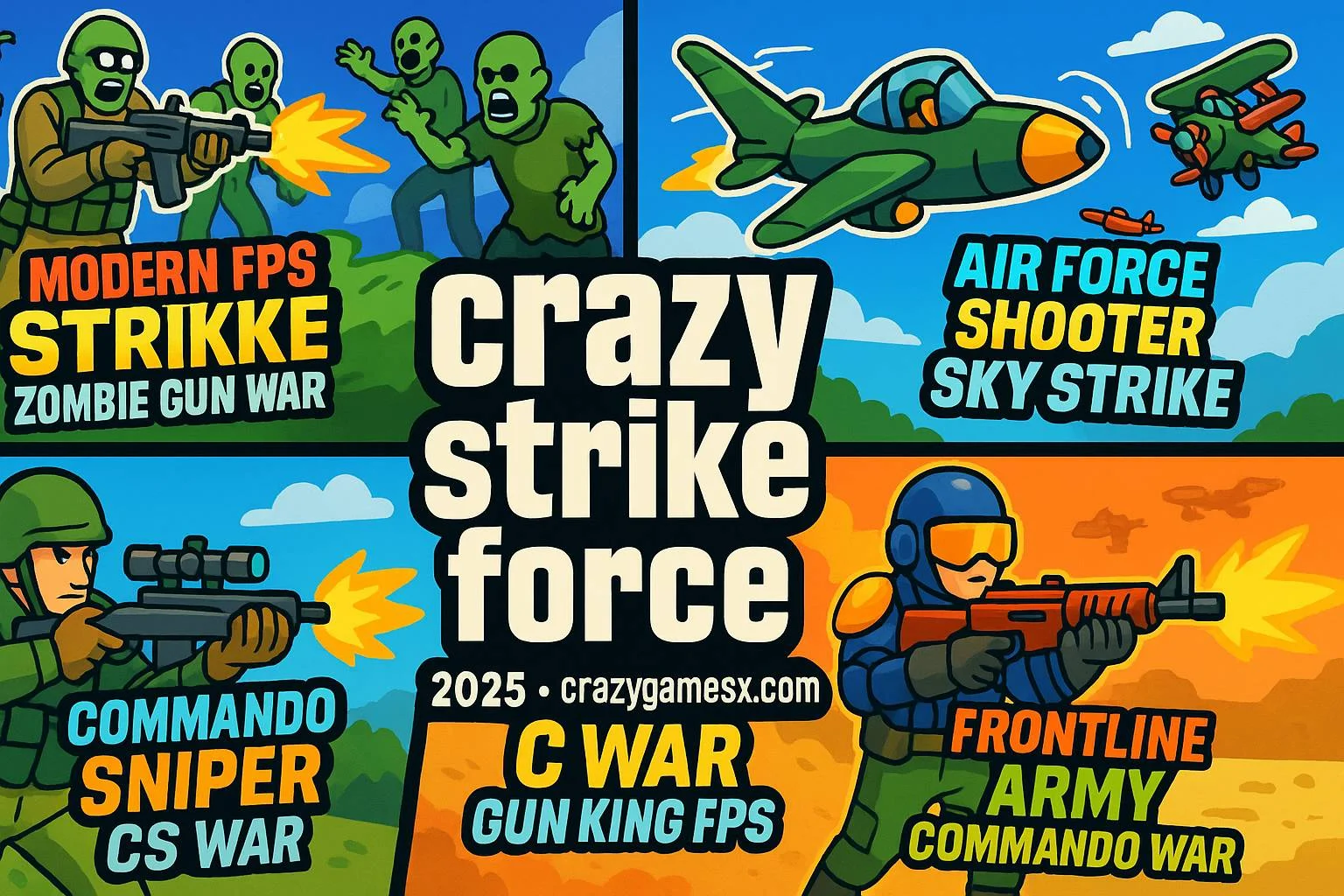
Modern FPS Strike Zombie Gun War Ops
If you like relentless pressure and target-rich chaos, this one throws you into close-quarters gunplay where ammo discipline and quick resets matter more than loadout spreadsheets. Expect tight corridors, fast TTK, and “live by your crosshair” pacing that rewards jiggle-peeks and dash-back reloads. Mid-round decisions hinge on whether to hold the power corner or swing into flanks, and the best players master both. About halfway through a match, make a tempo call—either anchor a choke or hunt picks—and stick to it, because indecision bleeds rounds. When you’re ready to lock in, jump straight into Modern FPS Strike Zombie Gun War Ops to pressure-test your tracking and positioning. It’s scrappy, it’s loud, and it’s perfect for sharpening your duel instincts without a 30-minute commitment.
Air Force Shooter Sky Strike
Prefer your firefights vertical? This entry tilts the battlefield into the sky, blending arcade shmup tempo with shooter-style threat triage. Surviving waves depends on reading projectile patterns, hugging safe lanes, and timing burst damage when enemy armor windows crack. It’s less about campers and more about spatial discipline—learning when to climb, dive, or strafe across lanes to maintain firing solutions. Mid-run upgrades feel meaningful without bogging you down, and boss sequences teach cooldowns and focus fire better than any tutorial. If you’re practicing awareness and precision, slide into Air Force Shooter Sky Strike and track multiple threats while keeping your reticle honest. It’s a clean way to train hand-eye and route planning while still getting that satisfying pop when a phase breaks.
Commando Sniper CS War
This one spotlights discipline: hold your nerve, hold your angle, and punish greed. Sniper-centric pacing means every peek is a contract—miss once and the counter-swing deletes you. Success comes from crosshair placement, pre-aimed head-levels, and impeccable strafing to break enemy timing. Mid-range rifles reward shoulder peeks and slice-the-pie entries, while long lanes demand patience and micro-corrections. Audio matters; footsteps and reload cues decide whether you swing or stay. When you feel your shot calling and patience leveling up, test it with Commando Sniper CS War and drill “peek, pause, click” fundamentals. It’s the perfect antidote to W-key chaos, teaching restraint that transfers straight back into crazy strike force endgames.
CS War Gun King FPS
If you crave rapid escalation, this mode shifts weapons as you rack up frags, forcing you to adapt aim patterns on the fly. The trick is recognizing each gun’s comfort zone—close burst, mid spray, or long tap—and steering fights into that lane before the switch. Movement becomes a tool to sculpt engagements, not just escape them. You’ll learn fast to chase isolated targets, cut rotations, and reset bad duels instead of forcing coin flips. Mid-match, momentum control is everything; a single two-kill swing can snowball your ladder. To practice instant adaptation, queue CS War Gun King FPS and treat each weapon swap like a mini-lesson in recoil, range, and rhythm. It’s chaotic in the best way, and it’ll harden your fundamentals.
Frontline Army Commando War
Team-forward players will vibe with this one: clear roles, readable lanes, and objective-centric pacing that rewards trading and space-taking. The frontline push hinges on two jobs—entry to crack space and anchor to hold it—while supports manage info and deny rotates. Utility timing matters: pressure one side, yank rotations, then hit the soft flank. Mistakes to dodge include dry-peeking power positions and stacking too many bodies on the same angle. Smart teams cascade pressure, force bad spawns, and lock exits. If you want to practice “win conditions over K/D,” load up Frontline Army Commando War and grind comms, trades, and objective discipline. The habits you build here—spacing, timing, and role clarity—translate directly into more closed-out games in crazy strike force.